
Sprint announces New Network Vision Plans for 2011
Sprint held a media conference call yesterday at 11:00 am announcing their plans to enhance services such as coverage, quality and speed. Sprint has awarded contracts to Alcatel-Lucent, Ericsson and Samsung to bring Network Vision to life by implementing multimode technologies that will do the enhancing for them.
Their goal is to create network flexibility, reduce operating costs and improve environmental sustainability as well as providing better coverage, quality and speed. Take a look at what Sprint had to say about their recent decisions.
“Network Vision builds on our legacy of wireless innovation and represents the next step in the evolution of our networks to best meet unprecedented growth in mobility services. We are well-positioned to take advantage of new technology, chipsets, devices and applications. Working with these three partners, we expect to deliver to our customers the most cutting-edge network capabilities available today and in the future.”
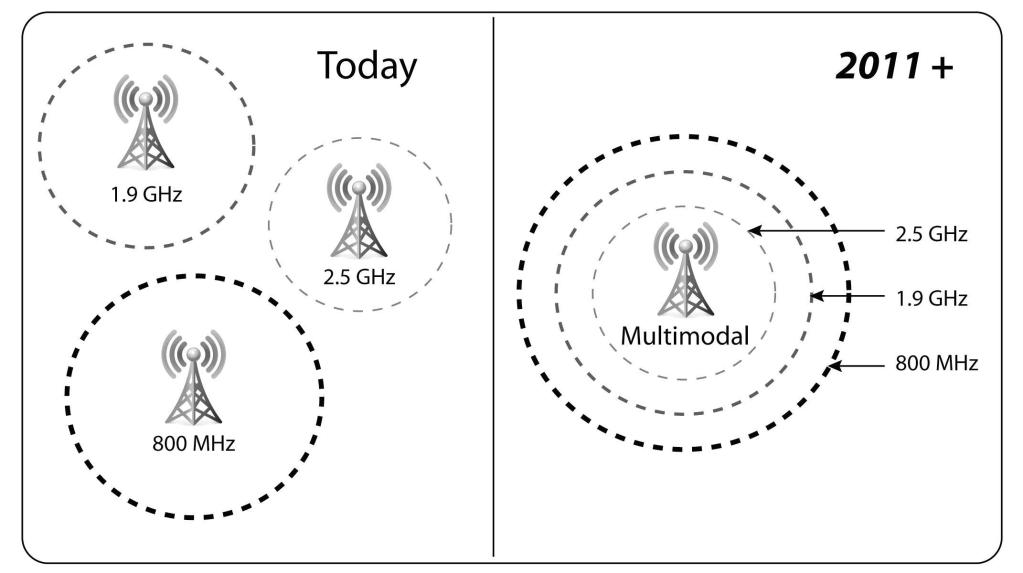
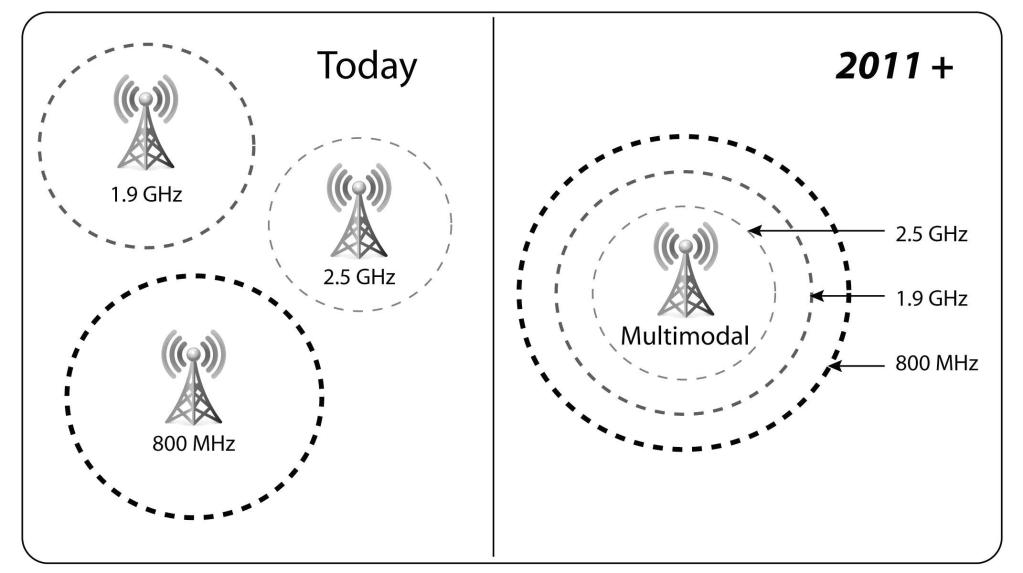
Currently Sprint uses separate equipment to deploy services on 800MHz spectrum, 1.9GHz spectrum and, through its relationship with Clearwire, 2.5GHz spectrum. With the New Network Vision Plans Alcatel-Lucent, Ericsson and Samsung will install new network equipment and software that brings together multiple spectrum bands on a single, multimode base station. (See ‘Current vs. New cell site’ at theSprint Network Vision Information Center.)
The implementation of multi-mode technology throughout the Sprint network is designed to:
- Enhance service – Improve quality and data speed; improve in-building coverage and coverage within the network footprint
- Create network flexibility – Ensure the most effective expansion of 4G
- Reduce operating costs by delivering capital efficiency, lease reductions, roaming savings and backhaul efficiencies
- Improve environmental sustainability by reducing carbon footprint and energy consumption needs
In addition to implementing multimode base stations, the Sprint Network Vision plan also encompasses next-generation push-to-talk (PTT) with broadband capabilities and the integration of multimode chipsets into smartphones, tablets and other broadband devices, including machine-to-machine (M2M) capabilities. Say what? Did you ever expect to hear that? I sure didn't with all the talk about Nextel going out of business or being sold to the government. Guess those rumors aren't true.
What do you think about these new plans? Let us know your thoughts!
Source: Sprint
Thanks Bored!
© 2010, GirlGoneGeek. All rights reserved.


Wow this is great news! I just hope these upgrades don’t take 6 years. A gradual roll-out beginning in January would be even more awesome news. This would fix my slow data and weak signal because I live on the edge of good service in a one block section of my neighborhood that is a near dead zone. I’m happy to hear that moregood things are coming to Sprint.
still waiting for 4g here in arizona.
so doe sthat mean wimax wave 2 will be rolling out then?
Just in time to battle 10G network LOL. Reminder, this is Sprint we are talking about.
Sprint is doing what they can. They do have stiff competition to deal with but I think Sprint is going in the right direction.
I agree with this guys prediction on where Sprint is headed with this and also makes perfect sense. http://connectedplanetonline.com/3g4g/news/2011-Predictions-Sprint-becomes-the-newest-LTE-operator/
I enjoy how Sprint has had it’s ups and downs, hiccups along the way, but they have always been trying to keep ahead revamping their network and customer service. Kudos to avoiding the carrier war and just working on stuff.. I also have to give it to Tmobile as well, quietly brilliant..
Hope this upgrade come to Puerto Rico
…….
Why didn’t they do that in the first place? I didn’t know they had a separate tower for each frequency. This is not forward thinking, its called common sense.
@NIKKG –
They didn’t do it at first because 1) They weren’t using the 2.5 spectrum, which means if they had revamped before to have one bi-mode tower then they would now be talking about combining two towers again. (The bi-mode and now the new 2.5) Which would’ve been more expensive.
Also they were really testing 4G more than actually rolling it out in the beginning. Which meant if Clearwire’s work wasn’t going to work they wouldn’t have to put old towers back up and instead would just shut down the new one. (Sorta like a desktop with seperate monitor and key board vs. an all-in-one or Laptop/notebook/netbook)
They were saving money by having seperate towers because they were utilizing old equipement to extend the shelf/use-ful life and make the most of their budget while expanding. (Then there was a scare about which Frequency Band they were going to lose to the government. – Which really would’ve put them in a pickle had they already combined the technology into a single tower.)
But now that those issues are past – this is the perfect time for technology integration. (Which says a lot- Ask around and see if T-Mobile or AT&T customers get the fastest speeds where they have voice coverage or heck even Verizon for that matter. If they were only using one type of tower you would have Full high speed, and not switching to 2G/1xRTT when your in the boonies – hence they are not using the latest broadcasting on the towers)